BesøgstiderLukket
|Søndag, September 20, 2026Ayasofya Meydanı, Sultanahmet, Fatih, 34122 Istanbul, Türkiye
Tilbage til mosaics
emperor
Constantine the Great Mosaic – Offering the City
Find Constantine’s portrait in the Southwest Vestibule and decode his offering of the city to the Virgin.
12/10/2025
12 min read
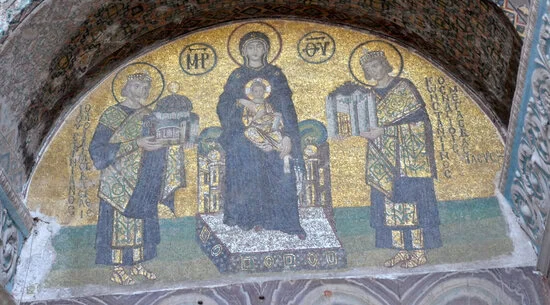
Constantine’s tiny city in his hands is a big idea: the foundation of Constantinople declared as an act of devotion and protection under the Virgin.
Where & When
- Find the scene in the Southwest Vestibule, beside Justinian. Both figures flank the Virgin and Child, turning founding myths into liturgical proclamation.
- The composition belongs to the 10th century, reflecting how later Byzantines re‑authored origin stories for a living capital.
Constantine’s City as Symbol
- The compact city model stands for walls, forums, aqueducts, and law — all condensed into a gift.
- By presenting the city to the Virgin, the mosaic frames politics as stewardship and intercession rather than mere domination.
The Pairing with Justinian
- Facing Justinian (offering the church), Constantine (offering the city) creates a program: state and sanctuary co‑support a Christian commonwealth.
- The symmetrical layout teaches a lesson every passerby can “read.”
Reading the Style
- Gold ground empties the “background” of time and place, emphasizing theological meaning over narrative realism.
- The restrained but expressive features invite contemplation rather than spectacle.
Viewing & Photo Notes
- The vestibule can be busy; expect brief viewing windows between waves of visitors.
- Use natural light and a steady hand; angle slightly to avoid specular glare on the tesserae.
Image Highlights
Bottom Line
In miniature, a civilization: the city itself offered back to God as a claim of responsibility and blessing.
Om forfatteren

Mosaic Storyteller
Jeg har lavet dette for at hjælpe dig med at møde Hagia Sophia med ro, kontekst og omhu—så store idéer, stille bønner og lysende sten taler klart.
Tags
Constantine the Great
Southwest Vestibule
Constantinople
donor imagery
Comments (0)
Leave a Comment
Loading comments...