Orari di aperturaChiuso
|Giovedì, Ottobre 22, 2026Ayasofya Meydanı, Sultanahmet, Fatih, 34122 Istanbul, Türkiye
Torna a mosaics
emperor
Justinian I Mosaic – Offering Hagia Sophia to the Virgin
A quick guide to the Justinian donor portrait in Hagia Sophia’s Southwest Vestibule and its political theology.
12/10/2025
9 min read
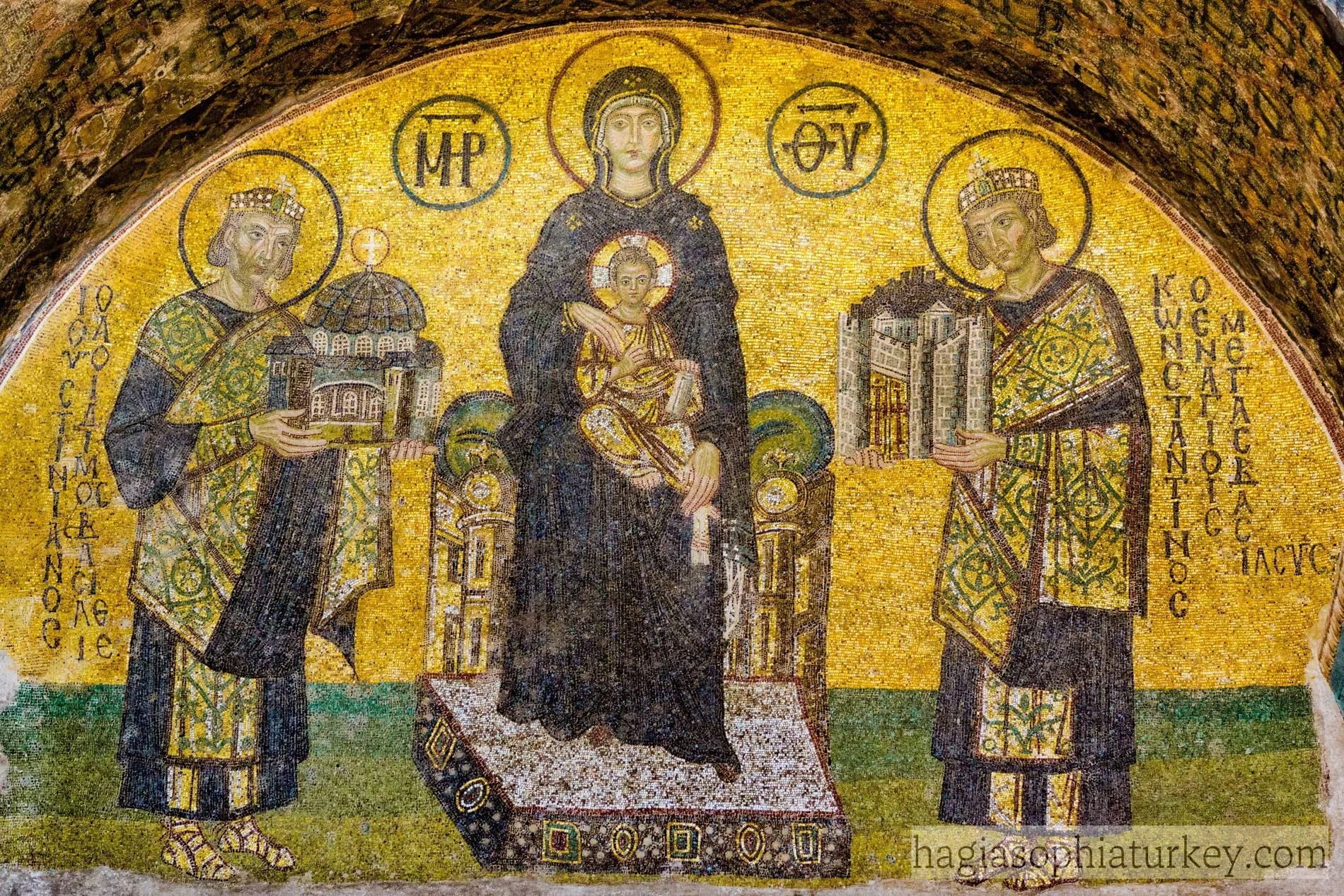
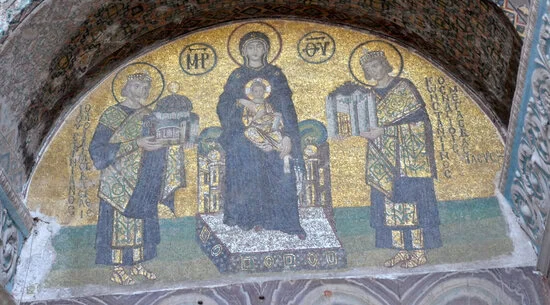
Justinian’s gesture condenses a whole political theology: the emperor presents his crowning achievement — Hagia Sophia — to the Virgin and Child. Empire becomes offering; architecture becomes devotion.
Orientation & Access
- Location: Southwest Vestibule, above the door toward the inner narthex.
- Period: The mosaic composition is dated to the 10th century, centuries after Justinian, reflecting how Byzantines remembered their greatest builder.
- Access note: Viewing conditions vary according to worship/tourist arrangements. Follow posted guidance and staff instructions.
Historical Background: Justinian’s Monument
- Hagia Sophia was consecrated in 537 under Justinian I, with architects Anthemius of Tralles and Isidore of Miletus.
- After early collapses and reinforcements, the vast dome became a lasting symbol of imperial ingenuity and divine favor.
- Later centuries re‑framed Justinian as an exemplar of pious rulership, pairing civic grandeur with sacred stewardship.
Reading the Iconography
- The Virgin and Child occupy the center, signaling that sacred authority outranks imperial rank.
- Justinian holds a model of Hagia Sophia: a visual shorthand for patronage, funding, and guardianship of orthodoxy.
- The pairing with Constantine (offering the city) stages a dialogue: founding the city and founding its greatest church.
Messages in Gold
- Donor imagery = public theology. Gifts (the church and the city) are shown as returned to God through the Virgin, legitimizing authority.
- The restrained palette and gold ground situate the scene in a timeless, liturgical space rather than a moment in court life.
Conservation & Visibility
- The panel was rediscovered and cleaned in the 19th century. Since then, conservation emphasizes stabilization over complete “brightening,” preserving historic patina.
- Expect variable glare. Subtle details emerge best in diffused light.
Photographing Respectfully
- Settings: wide to moderate‑wide; keep ISO reasonable to avoid noise in darker vestibule conditions.
- Avoid flash/tripods; do not block circulation around the doorway.
- If crowds form, take one quick frame, step back, and review later.
Related Highlights
- Pair this with the Constantine panel beside it and, upstairs, the Komnenos and Empress Zoe mosaics to trace changing imperial rhetoric.
Image Highlights
Bottom Line
This is the empire’s mission statement in glass: power justified as service, city and sanctuary entrusted to the Mother of God.
L'autore

Mosaic Storyteller
Ho costruito questo per aiutarti a incontrare Santa Sofia con calma, contesto e cura—così idee grandi, preghiere quiete e pietre luminose parlino chiare.
Tags
Justinian I
Southwest Vestibule
Virgin and Child
donor imagery
Comments (0)
Leave a Comment
Loading comments...